
Wearable Art Handbags: When Original Paintings Become Luxury Fashion
What happens when a painting leaves the canvas?
It can enter a gallery, a private collection or an exhibition.
But it can also enter everyday life.
A new generation of wearable art handbags is transforming the relationship between fine art and fashion—turning original artistic expression into something that can be carried, styled and experienced beyond the walls of a gallery.
A MAMTA JHARIA, this relationship between art and fashion is at the centre of our design philosophy.
Each artist handbag begins not with a trend forecast or a conventional surface pattern, but with an artistic idea.
A portrait.
An expressive eye.
A botanical composition.
An abstract form.
A line.
A colour.
A feeling.
The challenge is then to transform that artwork into a sophisticated handbag without losing what made the original painting powerful.
The result is something between two worlds:
part fashion accessory, part moving canvas.
What Is a Wearable Art Handbag?
A wearable art handbag is more than a bag decorated with an attractive print.
At its strongest, wearable art begins with genuine artistic authorship.
The image has a story before it ever reaches the handbag.
The artwork is then interpreted through fashion—considering the shape, proportions, leather, hardware, stitching and architecture of the finished piece.
This distinction matters.
Printing an image across an entire bag is relatively simple.
Transforming a painting into a luxury object requires much more consideration.
Which section of the painting should remain?
Where should the artwork begin?
Where should it stop?
How much negative space should surround it?
How will the image interact with the handles?
Will a seam interrupt the most important part of the composition?
Should the colours remain intense or become more restrained?
In a carefully designed artist handbag, the original artwork and the physical object must work together.
Neither should overpower the other.
Why Art and Fashion Are Moving Closer Together
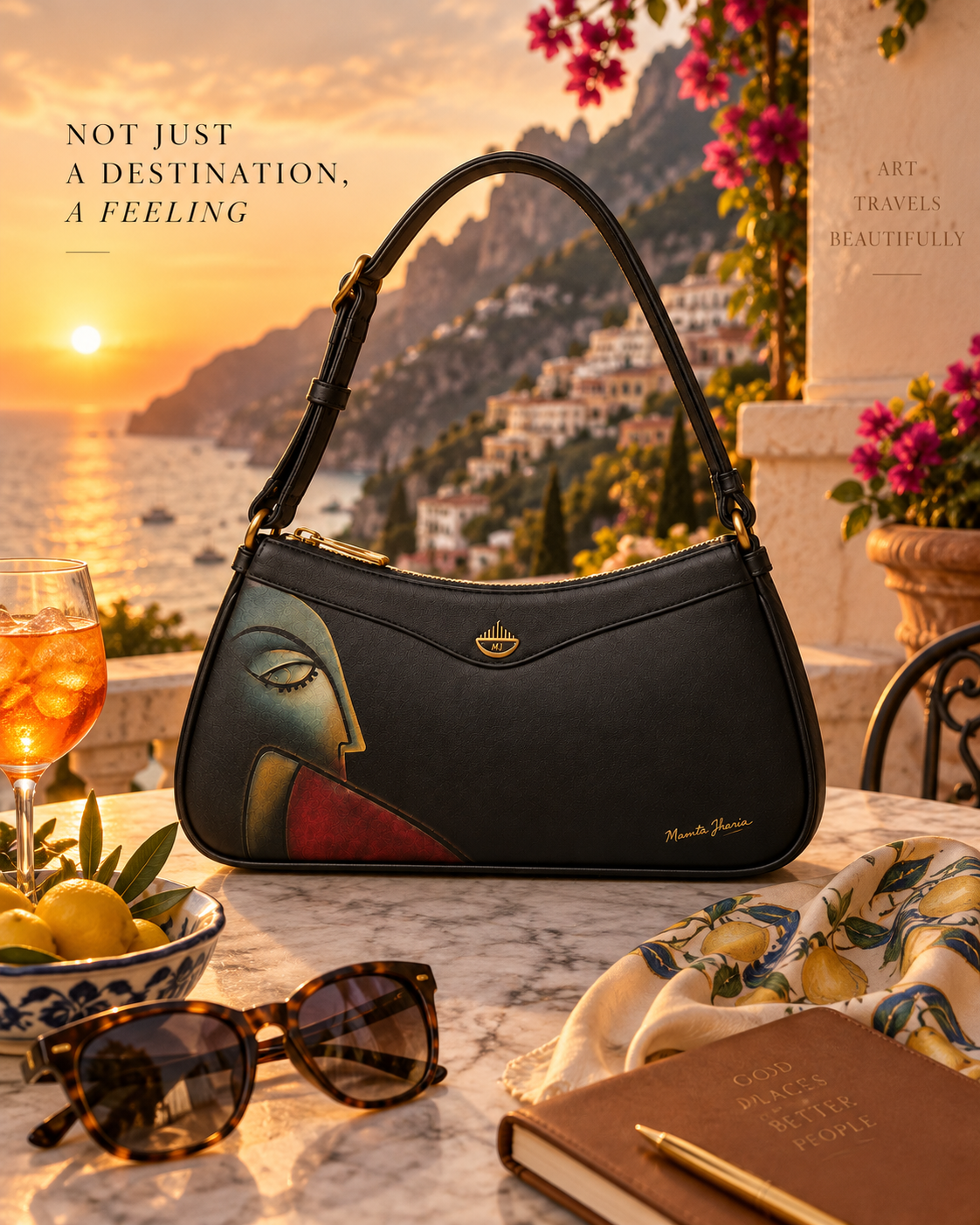
The relationship between art and fashion is certainly not new.
Artists and designers have influenced one another for generations.
What is particularly interesting today is how explicitly luxury fashion continues to move toward art, cultural institutions and artistic storytelling.
In 2026, Vogue highlighted how Gucci, Dior and Louis Vuitton all leaned strongly into art for their resort collections, including museum partnerships, cultural settings and artist collaborations. The publication described a broader movement in which fashion is increasingly using art and culture to create deeper forms of storytelling.
This tells us something important about contemporary luxury.
Customers are not only interested in the object.
They are increasingly interested in the world around the object.
Who created it?
What inspired it?
Where did the image come from?
What does it represent?
What makes this design different from thousands of other handbags?
For an artist-led fashion brand, those questions are not an added marketing story.
They are part of the product itself.
From Original Painting to Handbag
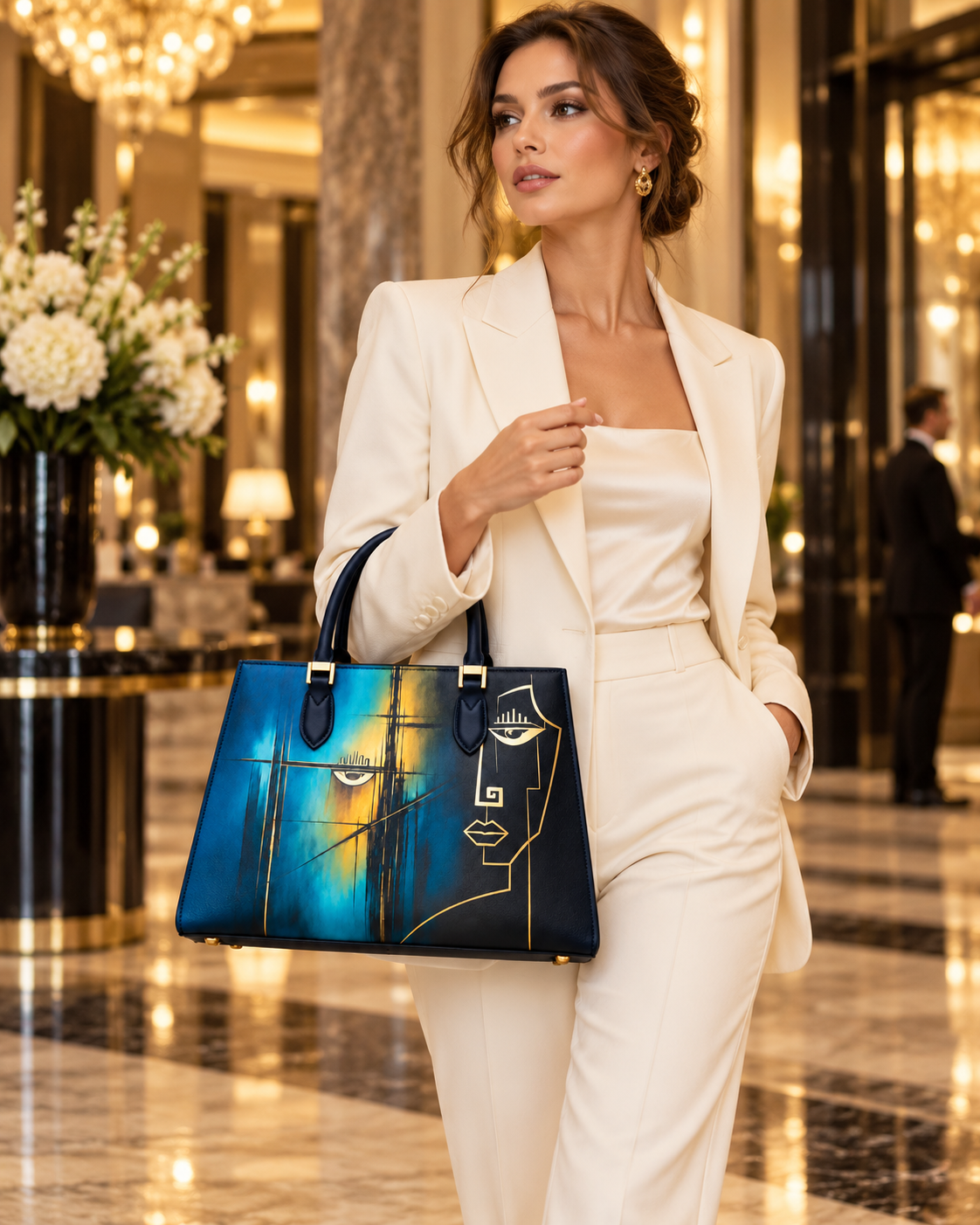
For MAMTA JHARIA, the process begins with original artwork.
But an original painting cannot simply be transferred mechanically onto every bag.
A canvas and a handbag behave very differently.
A painting is normally viewed from the front.
A handbag exists in three dimensions.
It has depth.
Handles.
Side panels.
Seams.
Hardware.
Curves.
Openings.
Movement.
The artwork therefore has to be recomposed for the object.
This can mean using only one fragment of the original painting.
A pair of eyes may become the focal point.
A face may appear partially rather than completely.
A botanical element may emerge from one corner.
A sweep of colour may occupy only the lower section of the bag.
Sometimes the most important design decision is not what to include.
It is what to leave empty.
The Importance of Negative Space
Negative space plays a major role in sophisticated art handbag design.
When every centimetre of a bag contains colour, imagery and decoration, the eye has nowhere to rest.
The artwork can begin to feel like a surface print rather than a deliberate composition.
By preserving areas of uninterrupted leather, the artwork becomes more powerful.
A single expressive eye on a black background can have more impact than an entire face covering the bag.
A small concentration of colour can appear more luxurious than colour everywhere.
This is why many MAMTA JHARIA designs use controlled artistic placement and generous negative space.
The bag remains elegant from a distance.
The artwork reveals itself as the viewer comes closer.
That balance between restraint and expression is fundamental to the collection.
Wearable Art and the New Meaning of Luxury
Luxury itself is changing.
McKinsey’s 2026 State of Luxury research found that emotional connection has become a leading driver of luxury desirability among surveyed customers in the United States and China.
Consumers increasingly want brands that reflect their identity, aspirations and values rather than functioning purely as visible signals of status.
That evolution creates an interesting environment for wearable art.
Art is emotional by nature.
Two people can look at exactly the same painting and have completely different reactions.
One may see strength.
Another may see vulnerability.
Another may respond primarily to the colour or composition.
When art becomes wearable, this emotional relationship becomes part of the fashion experience.
The customer is not simply choosing:
“Which colour bag matches my clothes?”
She may also be choosing:
“Which artwork feels like me?”
That is a very different purchasing relationship.
Individuality Is Becoming More Important
Fashion consumers are also becoming increasingly selective about where they spend.
McKinsey’s 2026 fashion research notes that consumers are scrutinising quality and craftsmanship more closely and, when they do decide to splurge, often want something special that expresses individuality and personality.
This is particularly relevant to independent designer brands.
A smaller luxury brand cannot—and should not—try to win by simply becoming a smaller version of an established global fashion house.
Its strength can come from offering something the customer cannot easily find elsewhere.
An artistic identity.
A recognizable visual language.
Limited production.
A direct relationship between creator and product.
This is where wearable art can become extremely powerful.
The Artwork Becomes the Brand Signature
Traditional luxury houses often build recognition around a monogram, a lock, a clasp, a particular quilting technique or a recognizable silhouette.
An artist-led brand has another possibility.
The artistic language itself can become the signature.
For MAMTA JHARIA, expressive eyes, faces, line work, botanical elements, geometric compositions and carefully controlled colour can create that recognition.
The objective is not for every handbag to look identical.
It is for different handbags to feel as though they come from the same artistic universe.
That distinction is important.
Recognition does not require repetition.
It requires identity.
Why Wearable Art Is Different From a Fashion Print
Fashion has always used prints.
Florals, stripes, animal motifs, geometric patterns and abstract graphics appear season after season.
Wearable art can go further.
A fashion print is often created primarily to decorate a surface.
An artist handbag can begin with an independent artwork that already contains composition, emotion and meaning before the product exists.
The design process therefore becomes one of translation rather than decoration.
How do you preserve the soul of the painting while turning it into an accessory?
That question lies at the centre of the MAMTA JHARIA approach.
Craftsmanship Must Match the Artwork
An original painting may create desire.
But artwork alone does not make a luxury handbag.
A premium bag must still perform as an object.
The leather must feel appropriate.
The silhouette must hold its form.
The handle must feel comfortable.
The attachment points need reinforcement.
The stitching needs consistency.
The edge finishing must be controlled.
The hardware should complement rather than dominate the design.
The interior must function properly.
And the zipper should operate smoothly.
This is particularly important for artist handbags because the artwork naturally attracts closer inspection.
Once someone notices the design, they begin examining the rest of the bag.
The artistic concept may create the first impression.
Craftsmanship determines whether the impression becomes trust.
Premium Leather as a Canvas
Leather offers an especially interesting foundation for wearable art.
Unlike a perfectly uniform synthetic surface, leather has natural character.
Its grain, subtle variation and tactile quality interact with the artwork rather than simply sitting behind it.
For MAMTA JHARIA’s premium collection, full-grain cow leather provides the physical foundation for designs intended to balance artistic expression with durability and everyday use.
Black leather is particularly important within the collection.
It creates visual depth.
It allows colour to emerge dramatically.
It also provides the negative space necessary for expressive artwork to remain sophisticated rather than overwhelming.
The result is an interesting tension:
the leather provides restraint; the artwork provides emotion.
Hardware Is Part of the Composition
Hardware may appear to be a purely technical decision.
It is not.
On a carefully designed handbag, every metallic element participates in the visual composition.
The size of a ring.
The width of a handle attachment.
The proportion of a clasp.
The shape of a zipper pull.
The position of a logo.
Even a few millimetres can change how refined a bag appears.
This becomes especially important when artwork is present.
Heavy hardware can compete with the painting.
Excessive branding can distract from it.
The most successful solution is often controlled hardware that frames the artwork without attempting to become the primary visual element.
Why Limited Editions Make Sense for Artist Bags
There is a natural relationship between original art and limited production.
A painting is valued partly because it comes from a specific creative act.
When that artwork is translated into fashion, producing the same object without limit can weaken the sense of connection between the design and its artistic origin.
Limited-edition handbags offer another approach.
The customer knows the piece belongs to a defined collection.
Production remains controlled.
The design retains a sense of individuality.
This does not mean exclusivity should depend entirely on artificial scarcity.
McKinsey’s 2026 luxury research suggests that consumers increasingly associate exclusivity with distinctiveness and insider recognition, rather than simply with a product being difficult to obtain.
That idea fits naturally with artist-designed handbags.
The value comes from knowing that the design is distinctive.
Not merely inaccessible.
A Handbag Can Become Collectible Design
The boundary between fashion object and collectible object has always been fluid.
Certain handbags eventually become culturally significant because of their design, craftsmanship, provenance or connection with a particular creative period.
Wearable art adds another dimension.
The artwork gives the handbag a visual identity that can potentially remain meaningful even after a seasonal trend has disappeared.
This changes the question from:
“Is this bag fashionable this season?”
to:
“Do I want to keep this piece?”
That is an important distinction for a luxury brand.
The objective should not simply be to create objects customers desire today.
It should be to create objects they remain emotionally connected to years later.
Fashion Is Becoming More Personal in 2026
Current handbag trends reinforce this broader movement.
Vogue’s Summer 2026 handbag report describes a market where personality and practicality increasingly coexist, with designers revisiting established silhouettes while giving them new character.
This combination is significant.
Customers do not necessarily want to choose between artistic design and practical function.
Increasingly, they expect both.
A bag can be visually distinctive while remaining functional enough for everyday use.
A wearable art handbag can hold a phone, wallet, keys and personal belongings just as any conventional handbag does.
But it adds another layer:
identity.
Art That Moves Through Everyday Life
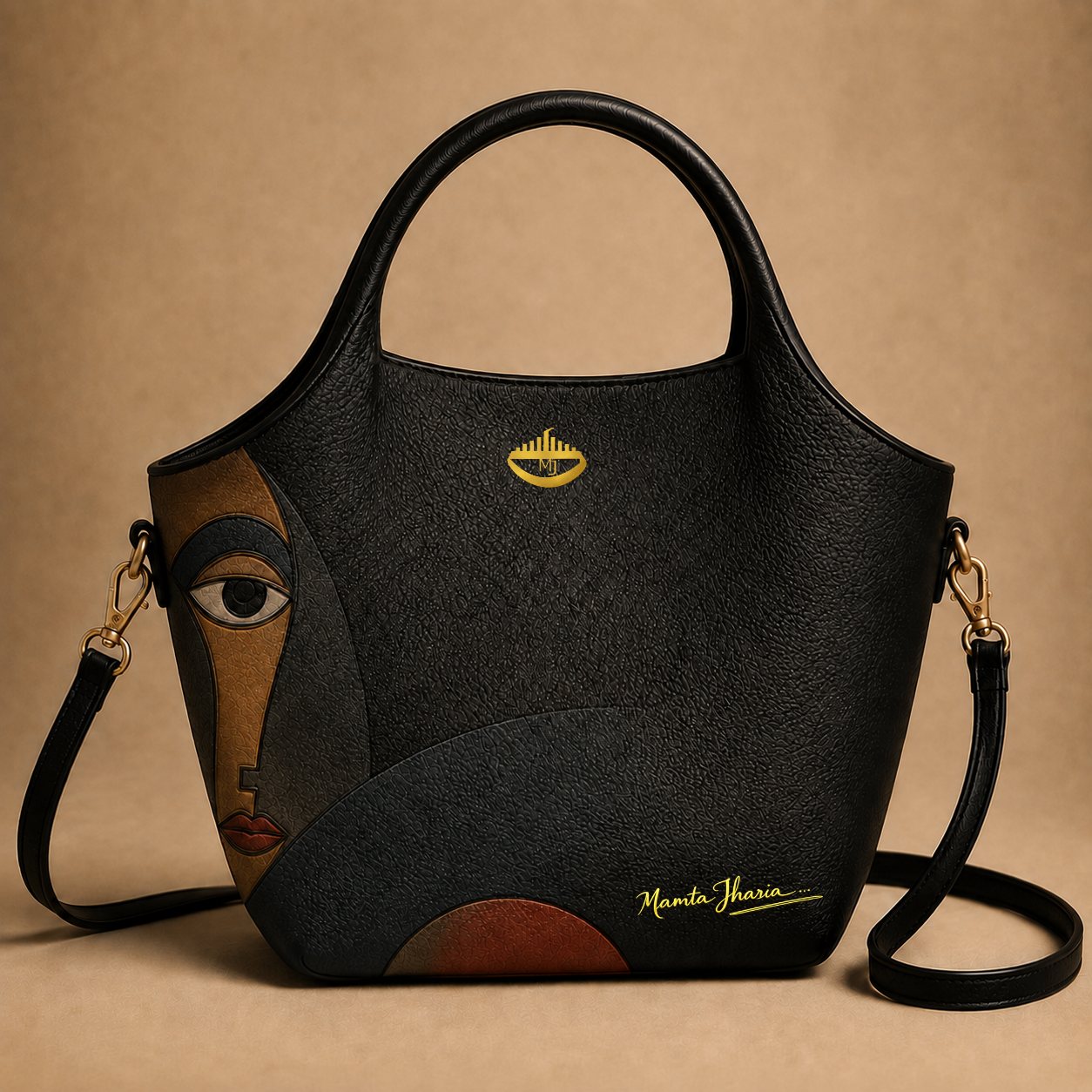
One of the most beautiful characteristics of wearable art is movement.
A painting in a gallery remains within its environment.
A handbag moves constantly.
It travels through airports.
It enters restaurants.
It accompanies its owner to work.
It appears at exhibitions.
It sits beside her at dinner.
It changes against different clothing.
Different architecture.
Different cities.
Different light.
In that sense, the artwork acquires another life.
It is no longer simply observed.
It participates.
That is what makes the idea of a handbag as a moving canvas so compelling.
How to Style a Wearable Art Handbag
An artistic handbag does not require an equally elaborate outfit.
Often, the opposite works better.
With Black
A monochrome black outfit creates an ideal frame for expressive colour or portrait artwork.
With White or Cream
Light neutrals provide contrast and can make dark leather particularly elegant.
With Tailoring
Pairing an art handbag with a structured blazer, trousers or a minimalist suit creates a sophisticated balance between creativity and formality.
With Denim
A premium art bag can transform simple denim, a shirt and clean footwear into a much more intentional look.
With Evening Clothing
Instead of using several statement accessories simultaneously, allow the handbag to function as the principal artistic element.
With Tonal Colours
Select one subtle colour from the artwork and repeat it elsewhere in the outfit.
The objective is not to match the bag perfectly.
It is to give it space to communicate.
Why Originality Matters in a World of Repetition
Modern consumers encounter thousands of products online.
Scroll through enough fashion images and many objects begin to look familiar.
Similar shapes.
Similar colours.
Similar hardware.
Similar styling.
Original artistic authorship offers a way out of that repetition.
A painting created by an artist is not the result of simply selecting another existing fashion motif.
It begins with a personal creative vocabulary.
That is why artist-designed fashion can feel more intimate.
The customer is buying not only an object.
She is entering a creative world.
Digital Product Identity and the Story Behind the Bag
The physical object is only one part of the story.
Modern product information can also help connect a customer more closely to what she owns.
For selected MAMTA JHARIA pieces, the Digital Product Passport concept can provide information associated with the handbag, including product identity, material information, care guidance and production details.
For wearable art, this digital layer is particularly relevant.
It can help preserve the relationship between:
the original artwork → the design → the physical handbag → the owner.
Rather than ending when the purchase is made, the story can remain attached to the product.
Choosing a Wearable Art Handbag
When choosing an art handbag, look beyond whether the image is immediately attractive.
Consider the complete object.
Ask:
Does the artwork have a distinctive identity?
Does it feel integrated into the bag or simply printed onto it?
Is there enough negative space?
Is the leather appropriate for the design?
How is the handle attached?
How are the edges finished?
Does the hardware complement the artwork?
Is the interior practical?
Would you still be drawn to this piece after current trends change?
And perhaps most importantly:
Does the artwork create an emotional response?
Because that emotional connection is what separates wearable art from ordinary decoration.
MAMTA JHARIA: From Canvas to Carry
The MAMTA JHARIA Artist Bag Collection is built around a simple idea:
original art should not have to remain on a wall.
It can travel.
It can become part of personal style.
It can transform a functional object into something expressive.
Original paintings provide the creative foundation.
Carefully selected compositions and negative space translate those artworks into fashion.
Premium leather, refined hardware, functional interiors and considered construction transform the artistic concept into a handbag intended for real life.
Selected pieces are created in limited editions, allowing each artistic collection to retain its own identity.
The result is not simply art placed on fashion.
It is an attempt to create something in which art and fashion become inseparable.
The Future of Luxury May Be More Personal
Luxury will continue to evolve.
Logos will remain.
Heritage will remain.
Craftsmanship will remain.
But the customer is increasingly asking another question:
“What does this object mean to me?”
That question creates extraordinary possibilities for wearable art.
Because an artist-designed handbag can communicate something that a conventional accessory may not.
Emotion.
Identity.
Individuality.
Story.
For MAMTA JHARIA, this is the idea behind every artist bag.
A painting begins on canvas.
But it does not have to end there.
It can become something you carry.
MAMTA JHARIA — Where Art Meets Elegance
Discover the MAMTA JHARIA Artist Bag Collection, where original paintings are transformed into limited-edition handbags combining artistic expression, premium materials and thoughtful craftsmanship.
Carry the art. Carry the story.
Where Art Meets Elegance.
 Italian
  English